How to Reduce Salon No-Shows Without Annoying Your Clients
A no-show is not always a careless client. Often, it is a booking with no confirmation, no reminder, and no simple way to reschedule. Here is how to reduce no-shows without turning client communication into a series of complaints.
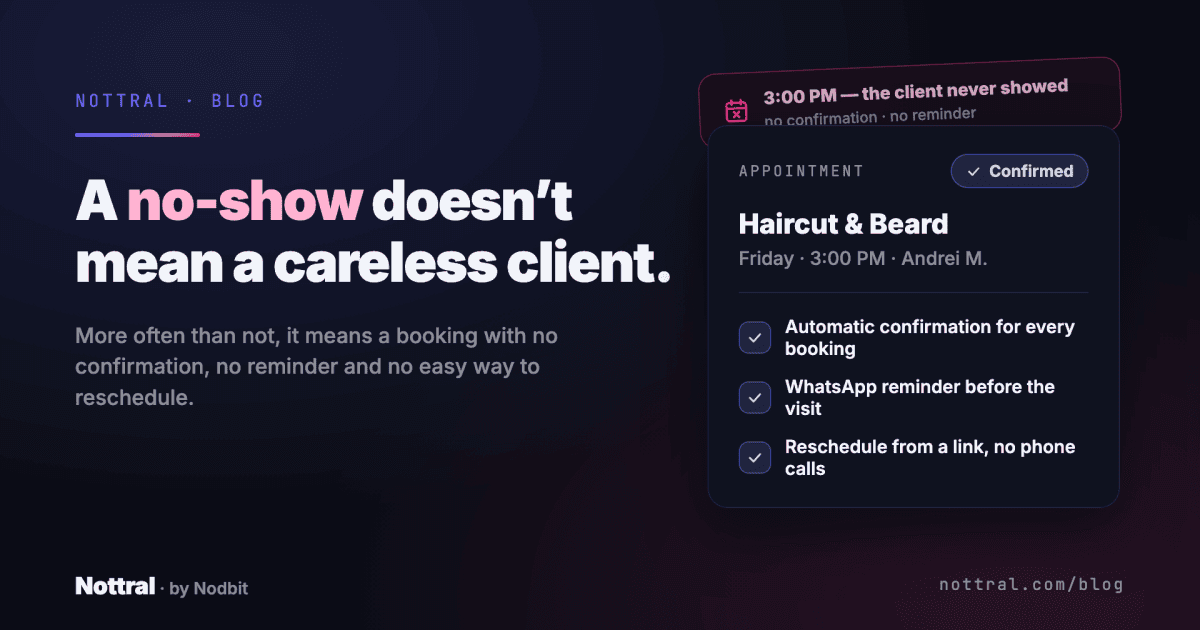
It is 3:07 p.m.
The station is ready. At 2:30, you turned someone away because the slot was booked. Now the client does not show up.
You text them. Sometimes they reply: “Sorry, I forgot.” Sometimes there is no reply at all.
The 3 p.m. slot is gone. You cannot sell it tomorrow. You cannot put it back on the shelf for next week.
The first reaction is easy: people do not respect appointments anymore.
Some people genuinely do not. But many no-shows have a simpler explanation: the appointment was made and then disappeared from the client’s attention.
That is where you can intervene.
A no-show is not just an absence. It is an hour you can no longer sell
In a salon, barbershop, or clinic, every slot on the calendar has value.
If you have a 3 p.m. appointment and the client does not show up, you do not just lose the time spent waiting. You lose the opportunity to give that slot to someone else.
That is why reducing no-shows should not be treated only as a client-discipline problem. It is an operational problem.
A good system does not assume that people will remember everything. It makes it easier for them to remember, confirm, or move an appointment.
Why do no-shows happen?
Not every absence has the same cause.
Sometimes the client genuinely forgets. They booked on Monday for Saturday and, by then, their schedule is full of other things.
Sometimes something changes at the last minute: a meeting at work, a sick child, a delay, or simply a day that no longer looks like the one they imagined when they booked.
Then there are impulse bookings made through Instagram or WhatsApp. The client says “yes, 5 p.m. works,” and the information gets buried inside a conversation with dozens of other messages.
In all of these cases, one thing is missing: a clear place where the appointment can be checked later.
That is the difference between an appointment that exists only inside a conversation and one that exists inside a system.
1. Send a confirmation immediately
The moment a client books, they should know that the slot is theirs.
A useful confirmation includes the essentials:
date and time;
selected service;
specialist, if applicable;
location;
contact information;
an option to change or cancel the appointment.
It does not need to be a long message.
“Your appointment is confirmed for Thursday at 3 p.m. with Maria for Gel. We are at X Street. If you need to change the time, use this link.”
That is enough.
The client should not have to search through old messages to find out where and when they are supposed to arrive.
2. Use reminders, not guilt
The confirmation says: you booked.
The reminder says: your appointment is coming up.
They serve different purposes, and both matter.
A reminder around 24 hours before the appointment gives the client time to notice a problem and reschedule.
A second reminder a few hours before can help with the simple case where someone has forgotten during a busy day.
You do not need five notifications.
A good system does not chase the client. It gives them the right information at the right time.
3. Make rescheduling easier than disappearing
This is where many businesses lose an opportunity.
If a client can no longer make it and the only option is to call during business hours or send a message and wait for a reply, rescheduling becomes a small problem.
When the problem becomes inconvenient enough, some people simply stop responding.
A rescheduling link changes that.
The client sees that 3 p.m. no longer works, taps the link, chooses 5 p.m., and moves on with their day.
For you, the difference is even more important: instead of a no-show, you have a moved appointment.
4. Explain your rules before the booking, not after
If you have a cancellation policy, the client should see it before confirming the appointment.
For example:
You can change or cancel your appointment free of charge up to 12 hours before the scheduled time. Late cancellations or repeated no-shows may be subject to a fee.
The exact rule depends on your service and business.
What matters is that it does not appear for the first time after the client misses an appointment.
A clear rule communicated in advance is easier to accept than a rule discovered after the incident.
5. Deposits can make sense, but they should not be automatic
For long services, highly requested time slots, or clients with repeated no-shows, a deposit can reduce risk.
But a deposit does not have to be the answer for every client.
A loyal client who visits every month for a 30-minute service is not the same as a first-time two-hour appointment on a Saturday.
If you require a deposit, explain how much it is, when it is charged, and what happens if the appointment is cancelled or moved.
Predictability matters more than severity.
6. Do not turn reminders into a notification campaign
More messages do not automatically mean fewer no-shows.
A client who has already confirmed does not need four more messages on the same day.
The purpose of a reminder is to help, not create friction.
A simple message is enough:
“Tomorrow at 3 p.m., you have an appointment with Maria for Gel. If you need to change the time, you can do it here.”
Clear information. One action. No unnecessary pressure.
What does not work very well
Calling every client manually before an appointment can work when you have very few bookings.
As the number of bookings grows, however, you start spending the exact time that online booking should be giving back to you.
Public messages such as “If you do not show up for your appointment, do not expect us to accept excuses!” do not solve the operational problem either.
They may communicate frustration, but they do not create a better process.
Hiding your cancellation policy does not help either. If the rules matter to you, they should be visible to the client.
What you can change this week
You do not need to redesign your entire business.
Start with four things:
Automatically confirm every appointment.
Send a reminder the day before.
Give clients a simple way to reschedule or cancel.
Show your cancellation policy before they confirm.
If you offer long services or deal with repeated no-shows, consider separately whether a deposit makes sense.
That is already a much stronger system than relying on the client’s memory and your own mental calendar.
A no-show does not have to become a conflict
You cannot eliminate every absence.
You can reduce them without turning your relationship with clients into a constant negotiation.
The confirmation puts the appointment in the client’s pocket.
The reminder brings it back to their attention.
Simple rescheduling gives them an easy way out when plans change.
Clear rules protect your time when the problem becomes a pattern.
You do not need more pressure.
You need a better process.
How Nottral helps
Nottral brings online booking, your calendar, and client communication together.
Clients can choose a service and time, receive confirmation, and get reminders before their appointment. If their plans change, they can manage the booking without every change having to go through a phone call.
You see the calendar. The client sees the appointment.
And, most importantly, you do not have to spend your day asking, “Are you still coming at 3?”