Why Clients Ask for Prices in DMs (and How to Stop It)
“How much is it?” in a DM is not always the start of a sale. Often, it is a question your page should have answered on its own. How to show prices clearly without turning Instagram into a customer-support desk.
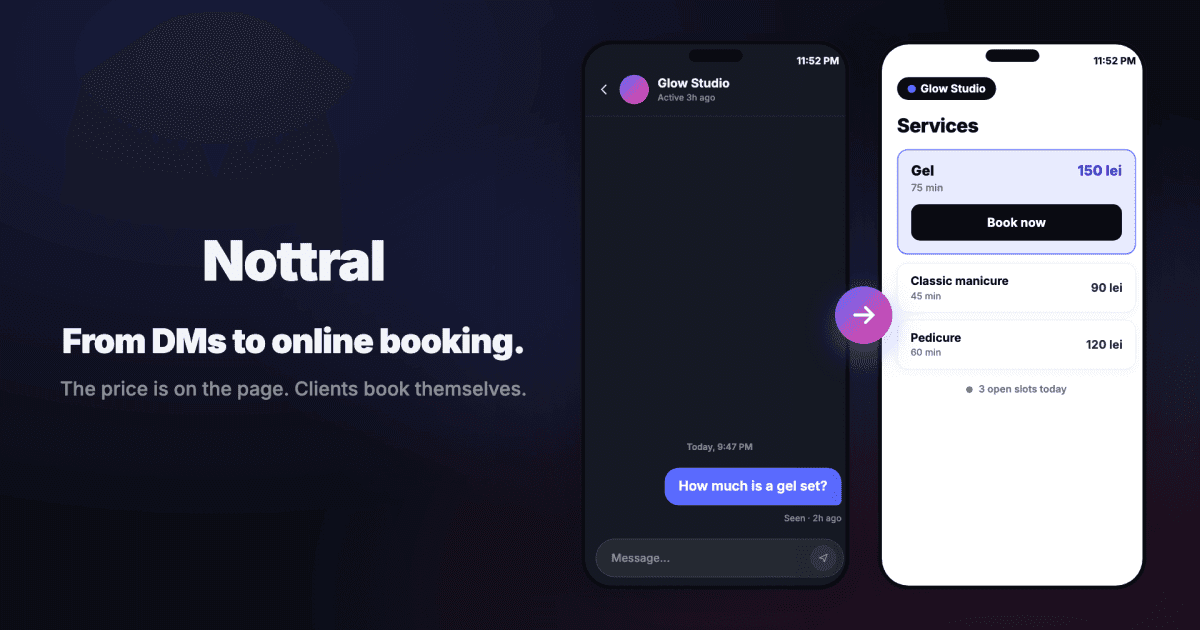
“How much is gel?” appears in your notifications as interest.
But often, it is a question your page should have answered on its own.
They found the salon. They saw the work. They did not find the price.
So they message you.
If you reply four hours later, some people are already gone. Not necessarily because they changed their mind. They may simply have found another salon that showed the service, price, and duration without requiring a conversation.
A price question in a DM is often a symptom. The cause is the page.
Why do clients ask for prices in DMs?
Not everyone is trying to negotiate.
Most people are trying to answer a simple question: “Can I afford this service, and is it worth the time I will spend there?”
If the price is missing, the client has to start a conversation to find out.
This commonly happens when:
prices are not shown on the website;
the service menu is hidden in a PDF;
the page only says “from” without a useful reference price;
Instagram shows the work but not the price;
the bio says “prices in DM”;
service prices vary but the reason is not explained.
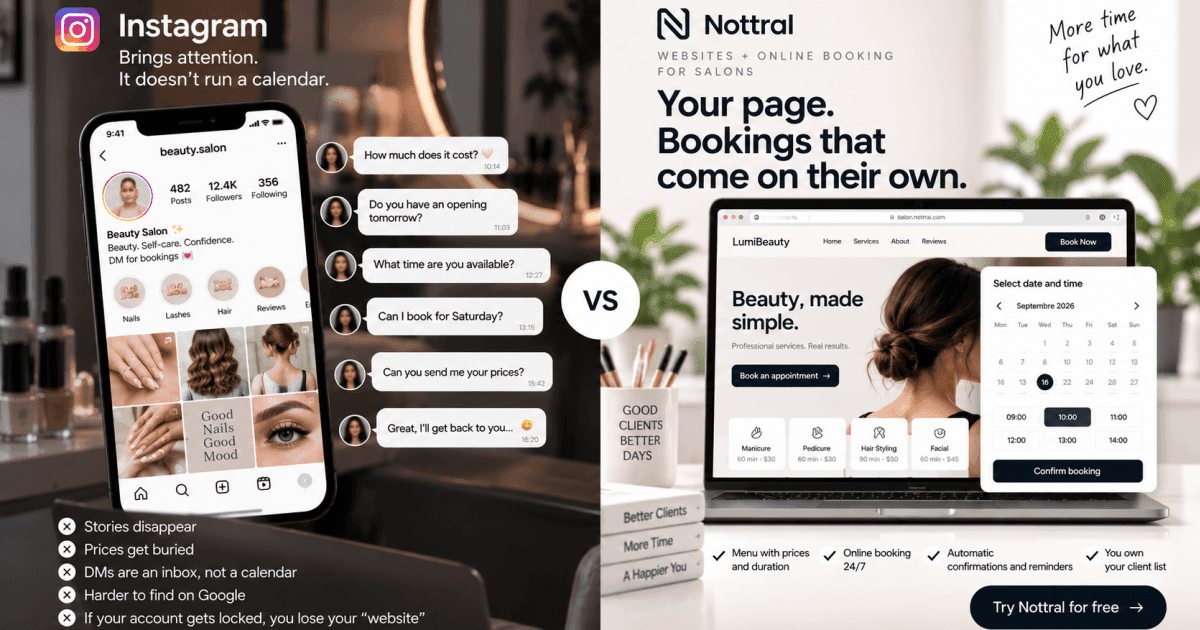
Instagram can show what you do very well.
But a photo does not tell someone how much a 75-minute service costs.
The page should.
Showing the price does not ruin your positioning
“If they see the price, they might not come.”
Sometimes, yes.
But that is not necessarily a problem.
If someone cannot afford the service, they were probably not the right client for that service anyway. The difference is that they now find out in seconds instead of through a ten-message conversation.
Hiding the price can create a different problem.
The client may assume the service is very expensive. They may assume the price depends on who they are. They may assume they need to negotiate.
None of those assumptions moves them closer to the Book button.
Transparency does not mean being cheap.
It means giving the client the information they need to make a decision.
How to show prices on a salon website
You do not need a 40-line catalogue.
Start with the services people book most often.
For example:
Gel — 150 lei — 75 min
Women’s haircut — 120 lei — 60 min
Manicure — 100 lei — 60 min
The client can understand the offer at a glance.
If the price varies, explain why:
Hair coloring — 250–450 lei — 2–3 hours, depending on hair length and product quantity.
A range is useful when there is a real variation.
“From” without an explanation is less useful. If you write “from 100 lei,” the client will ask what the 100 lei actually covers.
And you are back in the DM.
Price and duration should appear together
Price alone does not always tell the whole story.
For a client, 100 lei for 30 minutes and 100 lei for two hours are very different propositions.
For every important service, show at least:
service name;
price or price range;
approximate duration;
what is included, when relevant;
a clear booking button.
This turns the page from a portfolio into a decision-making tool.
What if your services have variable pricing?
Some services cannot have one fixed price.
Coloring, complex treatments, very long hair, or customized packages may depend on several factors.
Do not hide that.
Explain it.
For example:
Balayage — 350–600 lei
Price varies depending on hair length, density, and product quantity.
If a consultation is required first, say so clearly.
Initial consultation — 50 lei
Used to determine the procedure and final price.
The client knows what happens before booking.
That reduces surprises and repetitive questions.
Do not put the price in one place and the booking button somewhere else
Once a client sees the price, they should be able to take the next step immediately.
Do not make them search for a second link.
Ideally:
Gel — 150 lei — 75 min
[Book now]
They can then see availability and choose a time.
The fewer steps between “how much?” and “booked,” the more useful the page becomes.
What still belongs in the DM
Not every question should disappear.
There are situations where a conversation genuinely adds value:
an allergy or contraindication;
a color correction;
a customized service;
a wedding or event package;
a situation the client does not know how to describe;
a question about a non-standard service.
That is where DMs make sense.
A service catalogue is not a conversation. It is infrastructure.
The better your page answers simple questions, the more relevant the conversations that remain become.
What do you do when someone still asks, “How much?”
You do not need to paste the entire menu.
Keep the reply simple:
“It is 150 lei and takes about 75 minutes. You can check availability and book here: [link].”
One answer.
One piece of information.
One next step.
But if the same question appears 20 times a week, it is no longer a reply problem.
It is a signal that the page needs work.
How to check whether you fixed the problem
You do not need to guess.
For one week, count conversations that start with:
“How much?”
“How much is a haircut?”
“How much is gel?”
“Do you have a price list?”
Then make the prices clearly visible and measure again.
If those questions decrease while bookings remain stable or increase, you removed friction.
If bookings decrease after showing the prices, then investigate separately whether the issue is pricing, the service, or the positioning.
Do not hide information because you are afraid of the reaction.
Measure it.
Price questions in DMs are a symptom. The cause is the page.
A client asking for the price is not necessarily asking for a conversation.
Often, they are asking for information.
If the information is already on the page, the client can decide independently.
If it is not, you become the interface between the client and a price that could have been visible in three seconds.
Showing the price does not make you cheaper.
It makes you less dependent on chat.
Nottral puts services, prices, durations, and online booking in the same place. Clients can see what matters and move directly to booking.
Not what they guessed.
What you chose to show them.